Show Store Sections+
Show Information+
Account+
Home CDE84682
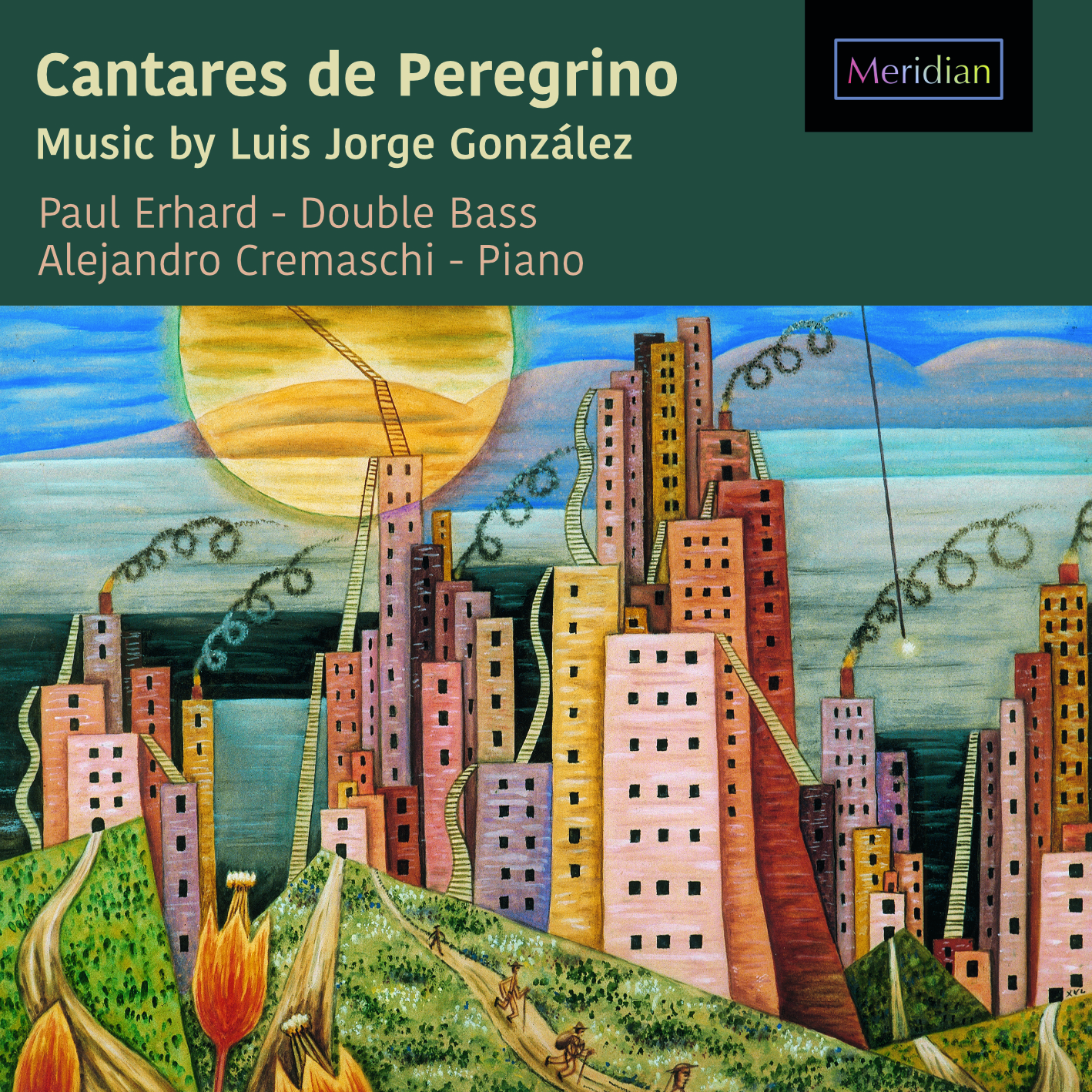
Cantares de Peregrino Music by Luis Jorge González
Paul Erhard - Double Bass Alejandro Cremaschi - Piano
Cantares de Peregrino / Wanderer’s Songs For Double Bass and Piano Arioso For Double Bass and Piano Chacona Tangante For Double Bass and Piano Zamba For Piano Sonata No. 1 “Del Plata” For Piano
This album brings together works from different periods of the Argentine composer Luis Jorge González’s creative life, revealing the breadth of his stylistic evolution and the richness of his passionate musical language.
González’s career unfolded across diverse geographical and artistic landscapes. Born in San Juan, Argentina, in 1936, he studied piano and choral conducting at the Universidad Nacional de Cuyo in Mendoza. His earliest compositions are rooted in a tonal, romantic nationalistic idiom. After moving to Buenos Aires, he encountered modern twelve-tone techniques through the Austrian musicologist Erwin Leuchter, and his music grew increasingly dissonant and experimental. This stylistic shift coincided with the vibrant avant-garde climate of the city in the 1960s. Buenos Aires at that time was a crucible of artistic ferment, energized by visiting European and American composers and by the bold interdisciplinary experiments fostered at the Instituto Di Tella, a focal point for the avant-garde.
By his own account, González struggled to find a place within this highly selective environment. After being denied a fellowship at the Instituto Di Tella, he returned to San Juan, disillusioned but artistically restless. There, while teaching music theory at the provincial university and directing a choir, his music moved between contrasting poles: on one hand, tonal works rooted in folk traditions—such as the music written for Mendoza’s Grape Harvest Festival in 1968—and on the other, modern, atonal compositions.
In 1971, González moved with his wife, Tati, and their young son, Javier, to Baltimore, where he enrolled as a graduate student in composition at the Peabody Institute. Immersing himself enthusiastically in the avant-garde, he explored then-current techniques including aleatoric procedures, extended instrumental methods, experimental notation, and electronic sound. This fascination, however, proved short-lived. By 1970s while living in Austin, Texas, González reconnected with Latin American art and poetry. Musicologist Graciela Musri has pointed out that the encounters with works of artists such as Fernando de Szyszlo—whose abstract paintings draw deeply on Peruvian cultural roots—prompted González to reassess his own aesthetic direction (Musri, 2000).
In the early 1980s, following a two-year return to Argentina and a final relocation to Colorado, González gradually moved away from strict avant-garde practices. Without renouncing atonality, he increasingly turned toward folk materials and Latin American sources. During this decade, he composed several large-scale works inspired by the art, myths, and histories of the original peoples of the American continent. In the 1990s, another powerful voice entered his music: the tango, the emblematic urban sound of Buenos Aires. Its rhythms, gestures, and emotional intensity became a vital expressive force in his work. Finally, in the last phase of his life—from the 2000s until his death in 2016—González returned decisively to a tonal language. These late compositions draw on the passion, color, and expressive immediacy of the Argentine tango, and affirm a musical voice deeply anchored in place, memory, and belonging.
This recording is the fourth album with music by Luis Jorge González released by Meridian Records. The performers on this album—double bassist Paul Erhard and pianist Alejandro Cremaschi—shared long and meaningful friendships with the composer during his years in Colorado.
Paul Erhard and González were colleagues for many decades at the University of Colorado Boulder. During those years, they performed frequently as a double bass/piano duo both in the US and abroad. During Erhard’s first weeks as faculty in Boulder, González introduced him to his work Sounding Solitudes for solo double bass, a work that had never been performed. Working closely with González to unravel the technical challenges, Paul premiered the work and performed it multiple times. Their close friendship and professional relationship inspired González to write a substantial body of music for the double bass. Many of these works were premiered by Erhard, and several received prizes in competitions in the United States.
Alejandro Cremaschi first met González in 2004, when he moved to Colorado to join the faculty of the University of Colorado Boulder. A close artistic relationship soon followed. González dedicated several piano works to Cremaschi, who has performed and recorded them for Meridian Records, helping to bring the composer’s music to new audiences.
The CD opens with González’s transcription of three songs he wrote in the early 1960s, with poetry by Argentine writers and collected under the title Cantares de Peregrino (Wanderer’s Songs). Written during the period of courtship of his future wife, these songs are moving and passionate tributes to youthful love. González returned to this cycle many times throughout his life, arranging it in different versions, including the present transcription for double bass and piano, premiered by Paul Erhard with the composer at the piano. The first song, El rosal de tu ventana (The Rosewood [sic] of Your Window), sets to music the poem Así by Arturo Capdevila. Rooted in the long tradition of Spanish-language love poetry, the text traces the emotional oscillation between ardent desire and the anguish of unrequited love. The second song, Visión, on a poem by Rafael Obligado, evokes a fleeting apparition of a beloved presence, now dissolved into the stillness of the countryside at dusk. The final piece, Crepúsculo, draws inspiration from Baldomero Fernández Moreno’s Crepúsculo argentino, capturing the dizzying immensity of the Argentine pampas at twilight and the almost religious awe it awakens in the poet.
Arioso, written in 1992 and revised in 1995, was dedicated to Paul Erhard and originally conceived as the slow movement of an unfinished concerto for double bass and orchestra. Suggestive, tranquil, and deeply contemplative, the piece evokes the pensive nostalgia of a slow tango, filtered through a language that recalls the Baroque aria. A subtle ground-bass impulse underlies the music, built over a syncopated, tango-like ostinato. Although largely atonal and often dissonant, the work opens brief “lagoons” of tonality. The demanding cadenza creates a fascinating contrapuntal texture using double stops, placing the double bass at the expressive center, after which the music gradually dissolves into silence on a high, suspended note.
Chacona Tangante (2002) is a fiery set of eleven virtuosic variations designed to showcase the double bass as a solo protagonist, exploring richly lyrical qualities in four registers of the instrument, low to very high. The word Tangante is González’s own invention, a gerund derived from tango, suggesting a music that is continually “tango-ing” through its unfolding movements. Drawing on the Baroque chaconne principle, the work develops a series of variations over a recurring bass line and harmonic progression, first introduced by the piano. Firmly tonal and unmistakably linked to the tango tradition, the piece brims with rhythmic vitality, syncopations, ornamental gestures characteristic of the genre, and powerfully expressive melodies typical of the composer.
The short and charming Zamba for piano, written in 1957, is among González’s earliest surviving works. The zamba is a rural dance genre, still practiced today and closely associated with the Argentine interior and gaucho traditions. González’s Zamba features characteristic 6/8 rhythms and frequent hemiolas, enriched by colorful harmonies and unexpected modulations that evoke an idealized, tender connection to the land.
The CD closes with the monumental Sonata del Plata, a virtuosic and demanding four-movement work written in 1991 and revised in 1993. One of González’s most ambitious compositions, it represents him at the height of his creative powers and marks a decisive step toward integrating tango idioms into an atonal language. In the composer’s own words, “richly diversified stylizations of rhythms and melodic features of the tango and milonga ... are used in each of the four movements... The musical language is freely atonal and designed to underline the flow of individual phrases and dramatic climaxes. Traditional forms ... enhance the intensely expressive contrasts of the tango, which are presented with controlled displays of instrumental virtuosity.” The first movement (Allegro) follows the broad outline of classical sonata-allegro form. The second movement (Scherzo) is a nightmarish tour de force, driven by an unstable, relentless moto perpetuo, from which melodic fragments emerge, before yielding to an evocative slow milonga in the central section. The third movement, a grave and introspective Passacaglia, provides a moment of reflection. The sonata concludes with an exhilarating toccata, marked by González’s characteristic shifting meters and surging climaxes, bringing the work—and the album—to a powerful close.
Paul Erhard has championed the double bass music of Luis Jorge González since 1986. For many years, the two performed as the Erhard/González Duo in the USA and Europe. Recitals included a González double bass work paired with standard solo double bass repertoire. With all of González’s music, Erhard’s playing is vocally oriented, creating singing lines that embody the passionate expressiveness at the core of González the person and composer. Erhard’s performance background includes classical double bass, jazz, improvised raga music of India, and solo improvisations that combine these musical traditions. With “Time Art Space Art” Erhard employs improvisation and composition to create multi-disciplinary works with painters, photographers, dancers, poets, actors, and film makers. Erhard is Professor Emeritus, University of Colorado College of Music in Boulder, where he taught for 37 years. Erhard’s double bass was made by Christopher Threlkeld.
Since meeting Luis Jorge González in 2004, and until his death in 2016, Alejandro Cremaschi frequently collaborated with the composer, and premiere several of his solo and chamber works for piano. The fruits of these collaborations were recorded and released by Meridian Records in three albums. Cremaschi is an active performer and researcher of the music of Latin America. His playing has been described as “pristine” and “passionate” by the Washington Post, and “polished” and “exemplary” by the Fanfare magazine. He has recorded music by Carlos Guastavino, Alberto Ginastera, Luis Gianneo and other Argentine composers. His edition and recording of Alberto Ginastera's Doce Preludios Americanos for piano was published by Carl Fischer in 2016, and superseded the original 1946 original edition of this work. Cremaschi studied piano with Dora De Marinis, Nancy Roldan and Lydia Artymiw. He is Professor of Piano at the University of Colorado Boulder.

 CDE84682